What We Cannot Know
by Marcus du Sautoy
Thursday, July 9, 2026
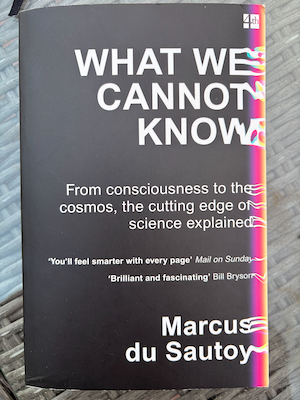
I keep picking up Marcus du Sautoy’s books and then not reading them. This one has been sitting on my bedside table for years now. I finally decided it was about time I read it or got rid of it. The book is all about digging around at the edges of human knowledge. Are there things that we know we’ll never be able to know about?
My own instinctive answer to the question is “no”. There are plenty of examples in history of people presuming stuff can’t be known but we eventually figured out what was happening, and why should today be any different?
It’s taken me quite a while to get through the book. Some parts were definitely more interesting to me than others. I’d say the interesting parts bifurcate into “stuff I already know a lot about and still like to read about” and “stuff I don’t know very much about and it’s fun to learn new things”. That seems kind of odd and I guess it means that there are some topics that I feel like I know enough about and they still aren’t engaging. And I rather don’t even want to name the stuff that I find uninteresting for fear someone tell me to read another explanation of the topic! The stuff I didn’t know much about that I found interesting were the brain science bits and the study of consciousness. And the maths bits are the bits where I can read the same explanations time and time again and still find them fascinating. And du Sautoy is a mathematician so he very much leans into the things that fascinate me as well.
The book is a decade old now (I’m not sure how long it’s been on my bedside table but probably most of that time, it’s definitely survived two house moves) and the chapter investigating consciousness is anchored around a chatbot called Cleverbot. I expected this material would have aged badly with how fast this technology has moved on since 2016 but actually the chatbot was only really used as a motif and the real content was about brain science. I certainly don’t think that the fact that the book is a decade old should stop you from reading it.
There’s a lot of meanderings into philosophy, and also into religion and whether a God can ever be compatible with science. I felt du Sautoy does a decent job of that but I’m sitting in the same place in atheism as he does so it’s not surprising that I think his view makes sense.
Gödel’s incompleteness theorems tell us, very roughly, that if you create a system of axioms then you can prove things with them but there are things that are true about that system that can’t be proved with just those axioms; you need to look at the system from outside to prove some things. And I think my takeaway from the book is that this is something that’s not just about mathematical logic. There are things in the universe that are true that we’ll never be able to prove are true.
The book is about probing around and trying to find out whether we know, or can know, what those things are. I wasn’t expecting there to be a list of bullet points at the end telling me the things we cannot know (just to be clear, there isn’t!) so I wasn’t disappointed. It’s an interesting read. In addition to the years unread in the wilderness it’s taken me four months to read my way through it. At this point I usually get annoyed with myself for reading books slowly but this one was definitely worth taking my time over, and it’s being transferred to the shelves where it’s granted indefinite stay for reference purposes.