Beloved
by Toni Morrison
Sunday, July 19, 2026
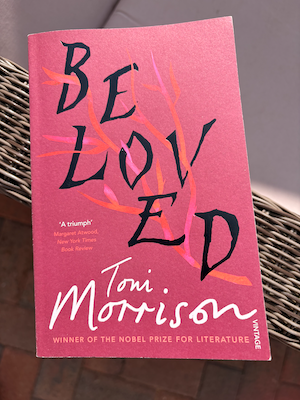
I don’t put a lot of stock in “books you must read” lists and often find them filled with books I don’t really think I’d enjoy but I still read them and still often find something I think I’d like. I had a scan through the The Guardian’s 100 best novels of all time when it came out a couple of months back. I’d read about 20 of the books already. It’s hard to figure out exactly how many because despite the fact I’ve been keeping records for 26 years I haven’t read any Thomas Hardy or Virginia Woolf in that time but know I read some previously but not exactly which ones. I guess it’s probably time I tried them again, but mostly I’d rather read new-to-me things. Middlemarch, which came in first on this list, was already on my list of books I ought to get round to reading, and still is. Beloved was the book that earned second place on the list, and the one I decided to add to my collection.
And it was both fabulous and profoundly disturbing. The writing is utterly brilliant and original and I really enjoyed it. The way the prose flows really brings the characters to life. When viewpoints switch, as they occasionally do later in the book, the prose is distinctly different. I’m not generally a fan of ghosts in books - I think I was burned early by children’s authors who used them as deus ex machina for getting out of any plot hole - but here the way that you’re never quite sure what is haunting and what is really bits of the character’s memories and experiences is very evocative. And I realise that I can’t actually remember when I last read a bad ghost story so I should probably lose that prejudice.
The story is centred around Sethe, who is escaping slavery with her young children when she gives birth to her daughter Denver, and the narration comes from a viewpoint eighteen years later when another slave she knew, Paul D, turns up on her doorstep. The events of the preceding years are gradually revealed as the book goes on. The farm on which Sethe, along with her husband Halle, and Paul D are slaves seems to be relatively benign1 and this is muddled up with some violent events that happen after Sethe escapes and it’s all rather confusing. But this is the kind of storytelling I really like, it lets you figure out what has happened and doesn’t spoon feed you. Lots of things that make little sense at the beginning of the book gradually fall into place as the whole back story is revealed. The way the picture slowly emerges is definitely a masterpiece of storytelling.
There are some awful descriptions of slavery here and you should be highly disturbed by them. I think we need fiction like this to remember the past with empathy so that we don’t repeat it. I’m very glad I read it. I love Toni Morrison’s own description of the book as being about “the pitched battle between remembering and forgetting” and I definitely plan to read more of her work now I’ve got started.
Footnotes
-
I’m aware that that seems that a really weird thing to say; and I need to add that I definitely don’t think slavery was ever good, but in the context of the story I think it makes sense. ↩