Howards End
by E M Forster
Monday, August 3, 2026
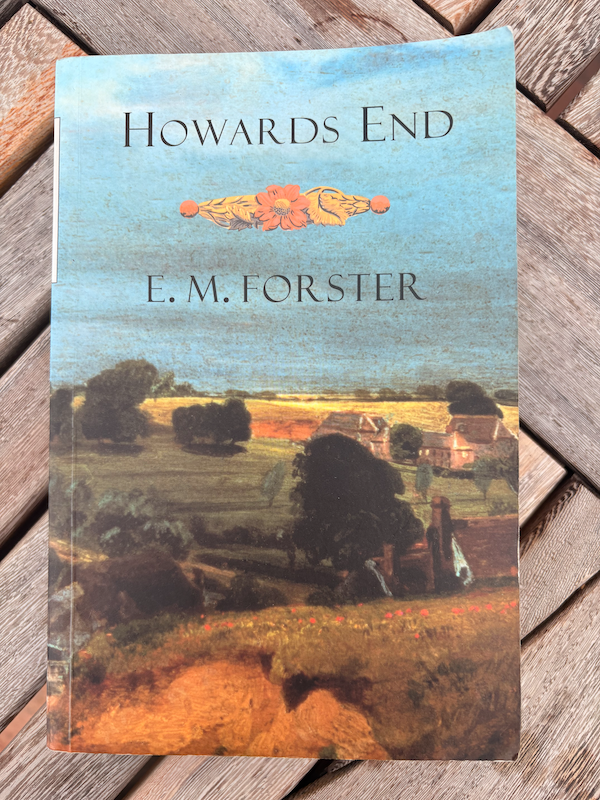
I’d never read any E M Forster so I started reading The Longest Journey which I found on a bookshelf at home. I was just a chapter in to it when Darren suggested I read Howards End instead which he’d found much more engaging. Both copies are his books but a bookmark shows he never finished The Longest Journey - that’s not necessarily a bad thing, he leaves a lot more books unfinished than I do, but I was happy enough to switch books and see what this one had to offer.
Published in 1910 this is a well structured tale examining the English class system. I’d expected the book to take place at the house named in the title but actually very little of it does but there’s a whole undercurrent about the relation of people and property. Most of the book is told from the point of view of Margaret Schlegel, the eldest of three siblings who have inherited their parents home in London. The book begins with her sister Helen having a brief unsatisfactory romance with one of the sons of the Wilcox family who live at Howards End, and then the two families twist together for the rest of the story. The business running Wilcoxes are better off than the more cosmopolitan and intellectual Schlegels but both are much wealthier than the third family - the working class Basts - who are added into the mix as well.
For me the book was as much about sexism as it was about class. And I’m really quite impressed with how insightful Forster is about the way women’s lives were constricted at the time and the condescending way they often get treated by the male characters. One of the sisters asks the man who has just asked to marry her (I won’t spoil the details) if he knows that she’s walked over the Apennines with her luggage on her back and his response is “I wasn’t aware, and, if I can manage it, you will never do such a thing again.” He hasn’t even married her yet! The complete deadpan delivery is fabulous. For a book with a strong political message it is very readable whilst still being beautifully written. There’s at least one rather bizarre plot twist but on the whole I’d say it well deserves to be a classic and I’ll definitely be reading more Forster. It easily grabs a place in my favourite novels list anyway (not that I know what else is on that list!).
And whilst I’m not particularly trying to read my way through it that’s the 22nd of The Guardian’s 100 best novels of all time that I’ve read.