Civolution & Sanctuary
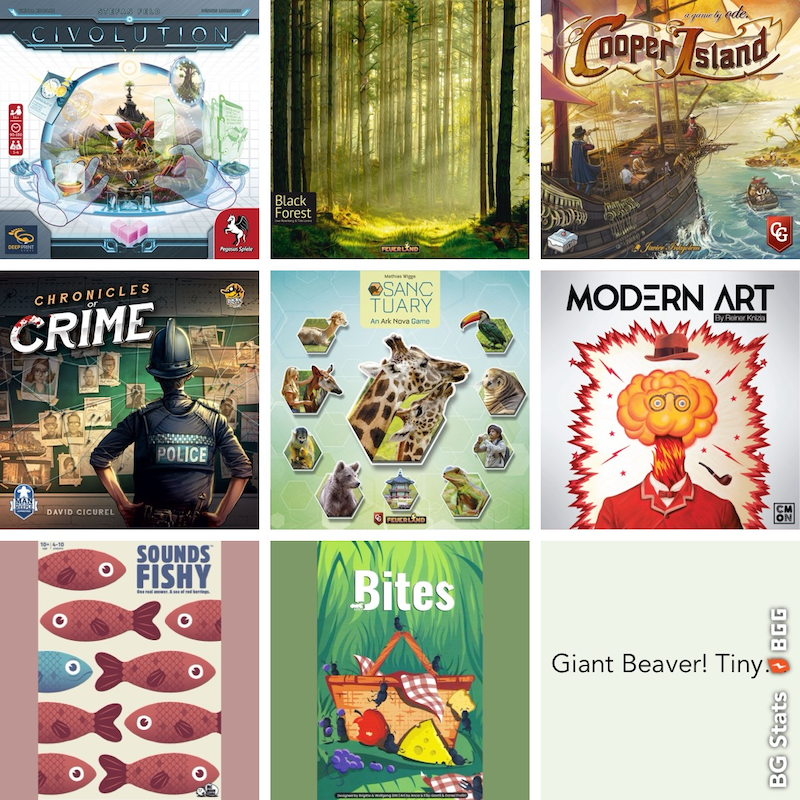
Nine more new-to-me games that do a good job of spanning the massive space between sublime and ridiculous, plus a bonus small card game because I can’t even find it in the BoardGameGeek directory of every board game ever. Sanctuary was certainly my favourite even though I forgot to take a photo of my zoo. I was surprised that I enjoyed Civolution so much but I definitely did.
Civolution

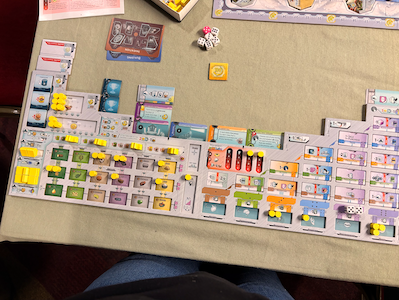
I’ve not quite been avoiding this game. I don’t usually shy away from heavier board games, but I’ve heard it described several times as having 30-something distinct actions, and it has looked about as exciting as a spreadsheet when I’ve seen it on the table, so I haven’t exactly jumped at the chance to play it. Turning up late to a game session I had a choice of this or another civilization themed game and ended up trying it out. And then I remembered that I love spreadsheets, of course I do, and it doesn’t actually look that grey and grid like once you are playing.
The theme is that you are some kind of sci-fi deity creating the perfect civilization and your player board is kind of your computer console to do so. You roll dice and can then use pairs of them to carry out different actions. You are creating tribes on a shared map in the centre of the table where you can explore and find locations or resources, or you can stay put and build monuments and farms to feed the people. Perhaps you’ll build boats, but there’s a weather mechanic so the boats might get taken out by a tsunami as happened in one round of our game. There’s a ton of different things going on and it is definitely a bit of an overwhelming rules teach but it quickly starts to make sense as you see how the elements roll together.
You’re not entirely at the mercy of the dice rolls. There are various ways you can use your dice to get things to mitigate later bad rolls but of course these take up actions that you’d rather use to do things directly. In fact it occurs to me now that it has some similarities with the system in Castles of Burgundy by the same designer - it definitely has more going on than Castles does but it’s not that off the scale to compare them. The main thing that makes it more complicated is the presence of numerous decks of cards. I’ve found these really hard to find synergy with. It is definitely a game that rewards adapting to what you have rather than sticking too closely to a plan. I ended up really liking it though, and jumped on a chance to play it again just a few days later.
Sanctuary
This is tagged as an “Ark Nova” game. Ark Nova’s a big game about building a big zoo and I thought this was going to be a much simplified edition of it. And whilst it’s definitely been simplified they haven’t dumbed it down. And it also kind of feels like the same kind of game whilst being a different kind of a game. In other words I think it’s a really well done design. The only thing I think they might have missed is that it’s still probably not a family weight game that you could happily introduce to non-board gamers. I wouldn’t be surprised if another “Ark Nova” game appears in the future to capture that market.
The action mechanism is much simplified and doesn’t really restrict you very much and there’s no money to deal with. It’s mostly a puzzle of taking the right hexagon tiles from the display and then placing them down on your board to score the most points. There are still conservation projects to support for getting certain numbers of the right kinds of animals or continents represented in your zoo. It is a lot simpler than Ark Nova but actually felt more of a puzzle at times. I basically ignored the conservation points and concentrated on maximising the points the tiles in my zoo were scoring and ended up winning the game but that might just be beginner’s luck.
One I’m hoping to have plenty of chances to play again in the future. I totally forgot to take a picture of my zoo before I tore it down which was a pity because I was really attached to it!
Black Forest
This has a gorgeous understated box but inside it’s exactly what you expect from a standard Uwe Rosenberg game. There aren’t any polyominoes actually but you’re still trying to fit squares and rectangles onto your map. But mostly it’s the return of the weird circle of resources from Glass Road. Any time you get enough resources together - sand, water, charcoal (there might have been another) - obviously you have plans for what you are going to do with these - but if you get one of each the wheel clunks around and you lose your resources and you’ve made some glass! And whilst glass is useful you might have wanted the other stuff, and maybe that only happened because someone handed you some free water. It’s fun and frustrating. And there’s a second dial that uses the same trick to create provisions from various foodstuffs. I only really figured out what was going on with these wheels after I finished playing though.
During the game I was wandering around a central map between a number of villages dealing with various tradespeople to buy or sell resources, or picking up pigs or cattle to bring back to my bit of the forest, or… I’ve forgotten what most of the actions were about now to be honest.
It was a fun game, and I’d happily play again but I felt I missed the theme in among the mechanics really.
Cooper Island
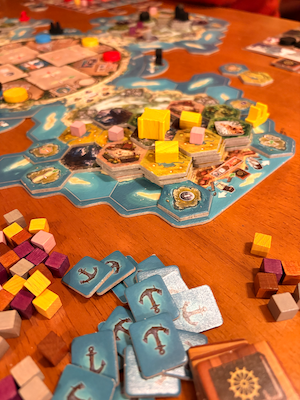
I love games where you get to stack tiles on top of each other and build three dimensional landscapes. In this game I did really well at building high, solving the puzzle of getting the right tiles in the right places to be able to do that, and the higher you build then the more resources the land gives to you each round. Unfortunately I didn’t also build up a system that turned those resources into points!
Each player’s island is connected to the others around the edge of the board and you have ships that sail round picking up bonuses, and eventually you sail off to go around your neighbour’s islands and pick up bonuses from them too. I found that this meant that it was difficult to see your own player board very well though. I’m probably making excuses for being terrible at the game… it was a reasonable game and I wouldn’t object to playing it again.
Chronicles of Crime
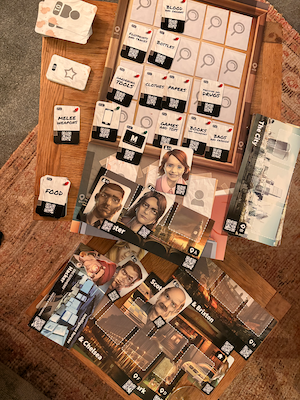
We’ve played several detective board games at home over the years. The Sherlock Holmes cases were fun and had great newspapers and other components but we never finished them. Detective was interesting and had more game to it but we never finished it. I picked this up for a fiver in the bring and buy at AireCon in March thinking we could try it out but it took us until November to get to it.
This is a game linked to an app. The app leads you through the crime that’s taken place and lets you view the crime scene on your phone to look for clues. You then find the cards in the game that match the clues you want to examine and scan the QR code on the card to get information. You also scan cards to move between locations or talk to your contacts about your finds. It was a bit clunky and a bit interesting at the same time.
You could happily play it solo, we played together over a drink and mostly eschewed the game board because it didn’t fit on our coffee table very well. In many ways it felt like it could have been just an app with no physical game box really, though we probably wouldn’t have played it together like that. I think we both enjoyed it, we didn’t figure out all of the mystery and weren’t really sure if we should have spent more time investigating. We got bonus points for answering quickly but our answers were incomplete.
We’ll probably play some more! I don’t think I’d recommend the game at full price but for the price I paid I’m quite happy.
Modern Art
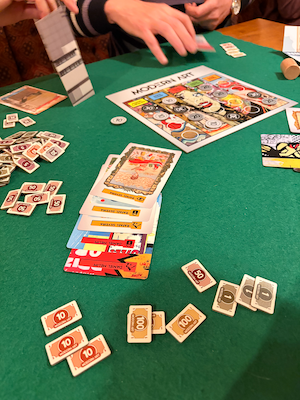
A game about trying to sell different artworks to your opponents and trying to end up with the most money. Whichever artist’s work sells the most ends up being worth the most, but will you have overpaid for it? A lot of this is just mathematical, which I’m fine with, but there’s also a psychological element of figuring out why your opponents are selling the works they are since they have a hand of other cards to play. And there’s also the fact that not all the auctions for the artworks work the same way - some are open bidding, others are first come first served, or sealed bids for example - that breaks the mathematical hold a little.
I’m not a fan of most auction games but this had enough structure that I enjoyed it, and I would have enjoyed it more if I hadn’t been playing with people who seemed determined that “all modern art is rubbish” which sweeping generalisation annoyed me but I couldn’t be bothered to argue with.
Sounds Fishy
This is a party game, for pretty much any number of players I think. One player has a card with a question on it. All the other players can see the correct answer. All the other players have to then answer the question, with one player giving the correct answer and others giving made up answers. Then the asking player has to determine which players are lying, scoring points for each liar they correctly identify, stopping anytime before they get it wrong. I think that was about it. It was silly, the questions are mostly celebrity themed, I actually knew the correct answer to one of them but not the one I asked. I’m a terrible liar and sometimes just can’t think fast enough to make plausible but wrong stuff up on the spot, but there were enough players that I quite enjoyed it.
Bites
I should have taken a photo of this as it had lovely components. Wooden ants making their way across a trail of chunky cardboard food to reach a big ant hill. As the ants eat the various foods the trail gets straighter just like a real ant trail. The players take the food and score points at the end based on matching the food taken to the position the ants end up in on the hill. Some of the components had different rules for each game which would vary it between plays. Light and fun.
Giant Beaver, Tiny Ass
BoardGameGeek doesn’t even have a box image for this! It’s an adult themed party trick taking game in which the suits are entirely innocent animals such as beaver, ass, cock etc and the suits are adjectives such as smelly, hairy and giant. Yeah. And you know what, it’s a long way from the worst trick taking game I’ve ever played and it was very silly. Obviously not one for the easily offended!
Cappuccino
I’ll include a bonus tenth game remark here since this one isn’t even in the BoardGameGeek database as far as I can tell.
This was a Japanese push your luck card game. Each player draws a card and adds it to the cup of coffee they are making on the table in front of them. The cards depict either coffee, milk or chocolate with a value and they have two different ways up with different values and ingredients on them. To make a scoring coffee you need to have the values of the ingredients add up to ten but the points you are scoring for it are detailed on the other end of the card. If you make certain combinations of milk, coffee and chocolate which are detailed as various coffee drinks then you can score extra points. But if you go over the ten value then you’ve bust. I liked the idea of the game but the scoring felt a bit wonky with some of the drink scoring values being so high that they were effectively game winners.