Inside the Box
by David Epstein
Saturday, August 8, 2026
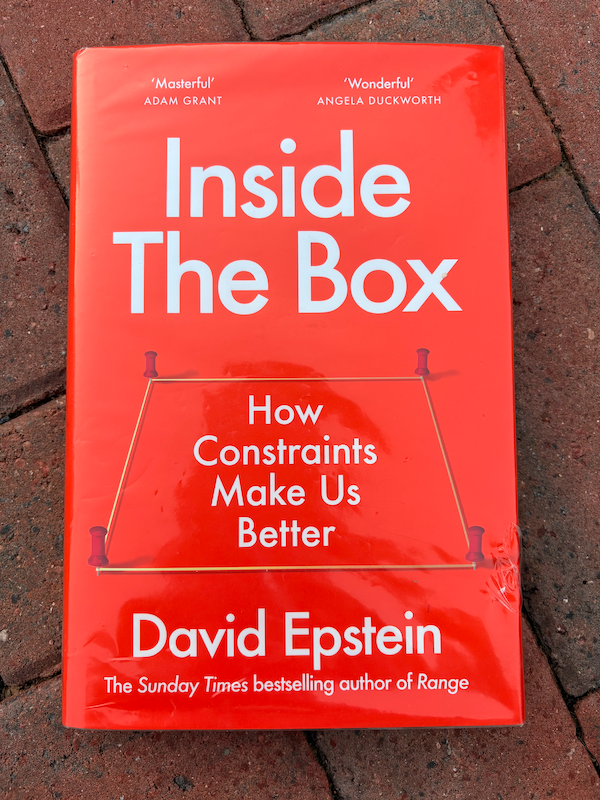
I was really looking out for David Epstein’s last book Range when I found this newer book of his and decided it sounded like a good read as well. This one is about “how constraints make us better”. That felt like the kind of thing I’ve slowly figured out over the course of my life and I was certainly up for a bit of confirmation bias.
The book walks through a series of examples of how companies with almost limitless resources have failed to do anything much whereas those who have, or are forced to, put tight constraints on creativity come up with much more innovative ideas. And after a while it all started to feel a bit repetitive. I wasn’t particularly surprised by the thesis so although it’s well written I wasn’t finding it especially informative.
It’s the kind of non-fiction book that I often let languish for a while at this point - I’ve confirmed the author’s talking sense but I don’t feel like they’ve got enough to say for me to want to finish the book off quickly. (I usually do finish books I’ve got half way through though.) I was definitely thinking I could let the book simmer a bit before reading the rest. Then I found that the library system wasn’t going to let me renew the book so, quite appropriately, there was a constraint on the time I had available to read the book.
The second half of the book got deeper into the hows and whys and I found it more engaging than the first half. The Theory of constraints is a whole management philosophy thing and I found the examples of people looking for and widening bottlenecks really interesting and probably useful. The end of the book was all about putting a positive spin on the idea of “satisficing” which is a term I’ve generally seen used in a negative way and I’ve gradually come round to the take that it’s fine to be fine with things being just fine over the course of my adult life. Epstein’s a fan of Four Thousand Weeks by Oliver Burkeman which I also liked for it’s light on this topic. There were quite a number of quotes and stories here that I’ve read before but it was nice to be reminded of them.
A lot of it is stuff that’s feels a bit obvious when you think about it but that’s rather the point - it has certainly been considered obvious that if you have infinite time and money you’ll be able to do great things but the evidence is against that. There’s a recurring thread through the book about Mendeleev’s miraculous solo breakthrough in creating the periodic table of the elements and how it wasn’t at all a miraculous solo breakthrough. I was finding that thread quite repetitive but the payoff at the end of the story is worth it.
It’s definitely a good book to read for anyone who doesn’t have infinite time or resources to play with (!), and though it was confirmation bias territory for me I definitely got some new things out of it.