A City on Mars
by Kelly and Zach Weinersmith
Friday, March 6, 2026
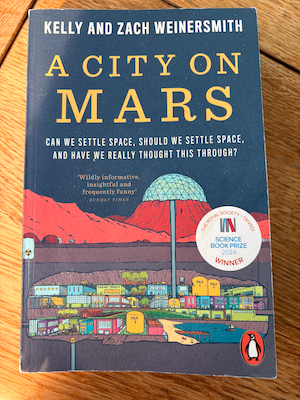
The subtitle of this book is “Can we settle space, should we settle space, and have we really thought this through?” and - spoilers - the answers seem to be maybe, a smaller maybe, and a big fat nope. One of the things that makes the book interesting is that the authors are probably more disappointed by those answers than their readers. And I think they’ve probably overstated the case for the “maybe”s to avoid falling out with a lot of people. Personally I find their arguments a breath of fresh air. Fresh air is something we have a lot of on earth that isn’t there on Mars, or on the other big space settlement option: the Moon. Even an overheated, plague ridden, asteroid hit version of Earth is so very much more hospitable to humans than anywhere else. I very much liked the analogy that moving to Mars to avoid climate change is like moving to a toxic waste dump to avoid tidying up your house. I’ll be using that in future!
My own feeling is that going to the Moon in the 1960s and 1970s and having an orbiting space station today - and don’t get me wrong, I think that’s amazing and it’s something I absolutely love - these are very much more about prestige than about the science. The authors point out that exploration has generally been more about fame and politics - “a short-term geopolitical advantage” - than the benefits of the actual exploration and I agree with them, space is no different. Are we doing the research that could lead to us living life in space? No, definitely not. There are guys blasting rockets and making inspiring speeches but it’s all very much not an actual plan. Are we researching how groups of people can live in closed ecosystems for long periods of time? No, because recycling, psychology and sex (to name but a few of the poorly researched fields) aren’t as interesting as shooting rockets out of the atmosphere. It kind of seems a bit odd to me that no one wants to research sex in space, but then I remember how little attention women and reproduction have historically got in the normal course of medical research and I realise that it’s not really a surprise.
The book is absolutely jammed with interesting stories. And there’s a very “well, actually” element to quite a few of them and I always enjoy having the record set straight. That story you’ve heard about how NASA wanted to send Sally Ride to space for a week with 100 tampons - there were women involved in coming up with that excessive number; it was all about safety margins and that the important thing is that no one wants to risk even coming close to running out in orbit. (And also, I don’t think this was mentioned in the book, but there are plenty of non-menstrual uses for tampons, they are a useful bit of emergency kit.) It’s also clear that a lot of things got left out of the book. I suspect the authors could write another on the things they couldn’t include. The book would have been an easier read without the section on space law. It was definitely the least interesting part of the book and the hardest to make fun. And I suspect most of the readers will be people who read science books for fun rather than people who read legal books for fun. But I think it was essential that it was included and it gave me quite a lot of understanding into why things are the way they are on earth, so that’s useful even if I never get to Mars.
Ultimately I came out of the book with the thought that if we can’t manage to live peacefully on a planet that has enough resources for all of us, then why (on earth) does anyone think that we’ll manage it on one that doesn’t. That is kind of a depressing takeaway but I found it a very funny book with lots of silly but relevant jokes that made it easy to keep reading. There’s a lot of light in with the darkness. I’d recommend the book, maybe especially to anyone who thinks living in space would be great.