The Secret of the Old Clock
by Carolyn Keene
Friday, March 20, 2026
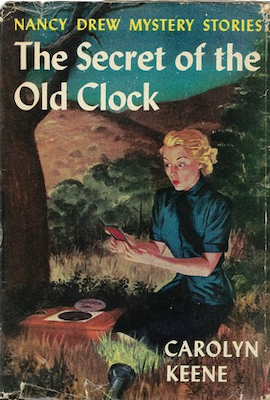
I never read Nancy Drew books as a child. They come up often when adult readers of mysteries get together though and when I saw the first few from 1930 were out of copyright and available for free on the internet I jumped on a pdf scan of an original copy to read. The mysteries I did read as a child included a stack of Famous Five books and probably my favourite children’s mystery series The Lone Pine Club, both of those series started after Nancy Drew in 1942 and 1943 respectively. I also read a load of girls school stories of this era such as the Chalet School (publication started in 1925, though I’ve mostly read later slightly updated editions) and a lot of random school stories that were lying around at libraries or homes of friends and family. So I thought I knew what to expect from a book of this era and I could almost feel the thick cheap paper that this book was originally printed on even though I was reading it on my iPad.
I expected to find it outdated and silly, quite possible offensive, but also to find it fun. However it pretty much annoyed me from beginning to end. Rather than reminding me of the stories I enjoyed as a child it felt like a precursor to the Sweet Valley High series. I read a handful of those belonging to friends as a teenager more because I was just a voracious reader than because I particularly enjoyed them. The California life of the Wakefield twins, big houses, sunshine and driving nice cars to high school, was too far away from reality to appeal to me. At least I vaguely knew the hills and coasts that the Lone Piners and Famous Five explored and I understood the pattern of their lives even if I didn’t go to boarding school myself. I didn’t work out where Nancy Drew was set but she had the big house, the sunshine and the fancy car that might as well put her in Sweet Valley.
Mostly though it wasn’t the details or the landscape that bugged me about the book but that the story just wasn’t engaging. Nancy hears that a local rich man has left his fortune to a well off family rather than his more deserving poorer relatives and determines, for no real reason that I could see, that this is incorrect and she needs to find his real will so that justice is done. It’s a really poor quality plot. A lot of the characters are bad stereotypes. The black character (I think there was only one) is the most cringeworthy of the stereotypes with a phonetically rendered accent to boot. That Nancy blunders into danger a number of times is the least of the book’s crimes, that’s exactly what I’d expect. And of course justice is done, it’s never in doubt.
It’s difficult to judge things by the standards I’m used to the best part of a century after publication, and a good forty years after I was the right age to find Nancy an adventurous role model. But I have read plenty of children’s books as an adult and have mostly enjoyed them for their easily readable and page turning plots. I won’t be bothering to read any more of these books. What I am most intrigued by is the fact that Sara Paretsky wrote an introduction to this book in the print edition. Paretsky’s VI Warshawski is one of my favourite fictional detectives and a very different character who comes from a completely different background to Nancy Drew, I’d love to know what Paretsky wrote about Drew.