Less
by Patrick Grant
Sunday, February 1, 2026
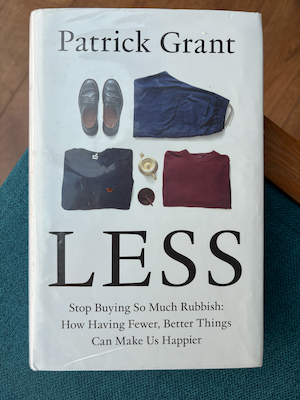
Well, this was an unexpected gem! I picked it up because I know Patrick Grant from the Sewing Bee on TV and he seems like a decent guy, and I’m basically on board with the argument that we could all do with buying less rubbish and I’m no fan of fast fashion to start with. So my expectations were pretty low I guess, I didn’t expect to learn a lot.
I wasn’t expecting a whole history of consumerism and how we got to this point where we want so much that we don’t need. (It dovetailed nicely with The Bookshop, The Draper, The Candlestick Maker - a history of the English high street - that I read recently.) Nor was I expecting him to lay out a whole - fairly politically pointed - plan for how manufacturing in the UK could be much better to all our benefits. (While I’m dovetailing things I’ll point out that if you like that bit of this book you might like Your Life is Manufactured that I read last year as well.) I was expecting plenty of railing about the excesses of the fashion industry, and I got it, though a lot of the statistics were still shocking. And I was expecting a large dose of Savile Row tailoring, and, as expected, that’s a thread that runs through the whole book.
As already mentioned, I’m not a fast fashion fan. I have a friend who claims that every woman would like to wear a new dress every day and I have no luck convincing her that that’s my worst nightmare. What I want is functional clothes that I’m comfortable in - both in the sense of personal comfort but also I’ve realised that there is the necessity of a bit of the sense of social comfort, I don’t want everyone else to think I’m a complete weirdo based on my outfit I guess! (Is there a right level of weirdo-ness? I feel like there is.) But wanting functional clothes that never wear out is what’s led me to make my own clothes. When my t-shirt eventually has more holes than fabric and dies then I can pull out the pattern and make myself a new one just the same. When the offspring was little I bought them a few outfits from Primark - kids grow out of clothes so fast and, I mean, how bad could they be? They were close to unwearable after one wash and I’ve never shopped there again. And as a result I’ve never been tempted to try any of the even faster fashion companies. I’m thinking that my friend’s desire for a new dress every day might have more to do with never buying anything of quality that lasts than an actual desire for novelty.
Clothes-wise then I’m totally on board with buying good stuff and making it last. I have several items in my wardrobe that predate the offspring (now away at university) and I have many items that I hope will have decades of wear in them. I think Grant mentioned that he thought ten new items of clothing a year ought to be enough so I looked back through my records and I didn’t even manage that last year. I don’t know that everything I buy is quality though, one of the eye-openers in the book was how little correlation there can be between expensive items and good quality ones.
There are three parts to his overall thesis though: buy less, better and local. I don’t think I do quite so well on the local. I flipped out around 15 years ago when I found out about Amazon’s UK corporation tax contributions (£0) and haven’t been enticed back yet, and nothing I’ve seen of the company since has made me think I’ll ever shop with them again. (And it should be said that’s been a stance that’s mostly saved me money by making impulse purchases harder, or making me do a bit more research and discover that actually prices are often cheaper elsewhere.) But generally the local bit of the equation is not something I put that much thought into but I’ll certainly be endeavouring to pay more attention to it from now onwards. And I could definitely do with paying attention to my consuming habits in other fields than fashion as well. The book does concentrate on textile industries in the main but makes it clear that all kinds of household goods need the same treatment.
Grant uses examples from his Community Clothing company throughout the book and when I reached the end I thought to myself, “Well, did I just read a 300 page advert for Community Clothing?”. And I think I did. But I don’t think that’s a bad thing. If every business person had to write a 300 page explanation of how their company works and impacts the world around them then I think that would be a much better advertising landscape than the one we put up with.
I’m surprised how much I enjoyed the book and how engaging it was. Definitely one that I would recommend.