The Glassmaker
by Tracy Chevalier
Friday, January 2, 2026
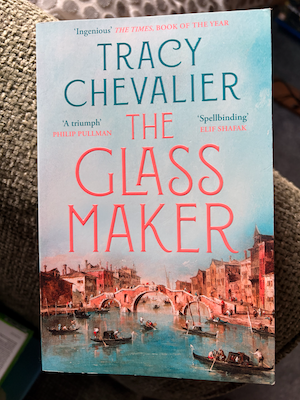
New years are weird. I have a longstanding aversion to the new year as a time to put resolutions in place and change your life up, but it’s still impossible for me to avoid thinking that maybe this is a good time to try and get on top of things and keep up to date. So here’s my first book review of the year published within a day of finishing the book. It’s also nice to start the year with a book I really enjoyed and would recommend.
This was my Jólabókaflóðið present for 2025 and it’s been magical. In more ways than one. The book is set in the Venetian lagoon and begins in the fifteenth century where Orsola Rosso is a young girl born to a glass making family on the island of Murano. And the book follows the Rosso family through time as society and the city change. But it’s not the usual type of family saga where successive generations are followed through the book. Instead the author lifts the same characters up and skips them forward through time, they get a little older each time but the same characters stay in the story for the best part of six hundred years. It’s the kind of thing I think I might have misgivings about but here I absolutely loved this technique. I liked that the author didn’t try to disguise the skips or the inconsistencies that had to develop as a result as time went on. Everyone in Venice was subject to the same kind of time so all the supporting characters aged and changed in the same ways.
I liked that Chevalier has included a lot of real history in with the fictional family story. And it was very much a book for looking up the locations in StreetView as you go along as well. I realised whilst reading that though I’ve enjoyed several of Chevalier’s other books I don’t think I’ve ever read her most well known work Girl with a Pearl Earring so that’s something I should remedy soon. I was unsurprised to discover at the end of the book that one of the characters in The Glassmaker was inspired by a painting too; it’s worth having a look at Carpaccio’s Miracle of the Relic of the Cross at the Ponte di Rialto whilst you are reading!